
UK Pet Law Guide
What to Put on a Dog Tag: UK Law Explained
Every dog in a public place in the UK must wear a collar with an ID tag – and getting the wording wrong can land you with a fine. Here’s exactly what the law requires, what we recommend adding, and what to leave off.
By Our Gift Shop · Updated October 2026 · 6 min read
The quick answer
Under the Control of Dogs Order 1992, your dog’s tag must show:
- Your name (the owner’s, not the dog’s)
- Your address, including postcode
A phone number isn’t required by law, but it’s the fastest way to get a lost dog home – so we always recommend adding one.
What does the UK law say?
The rule comes from the Control of Dogs Order 1992. It says that any dog “on a highway or in a place of public resort” – in other words, anywhere public such as roads, pavements, parks and beaches – must wear a collar with the name and address (including postcode) of the owner on it. The details can be engraved or written on the collar itself, or on a plate or badge (a tag) attached to it.
It applies across England, Scotland and Wales, and it applies whether or not your dog is microchipped.
Can you be fined? Yes. Not having a compliant tag is a criminal offence, and owners can be prosecuted and fined – the maximum is often quoted as £5,000. Dog wardens can also treat an untagged dog as a stray.
What must be on a dog tag?
Only two things are legally required:
- Your name. Surname with an initial or title (e.g. “J. Smith” or “Mrs Smith”) is fine.
- Your address, including postcode. Tags are small, so most owners engrave the house number or name, the first line of the address and the postcode.
- ✔ Legally required: owner’s name
- ✔ Legally required: address & postcode
- ★ Recommended: mobile number
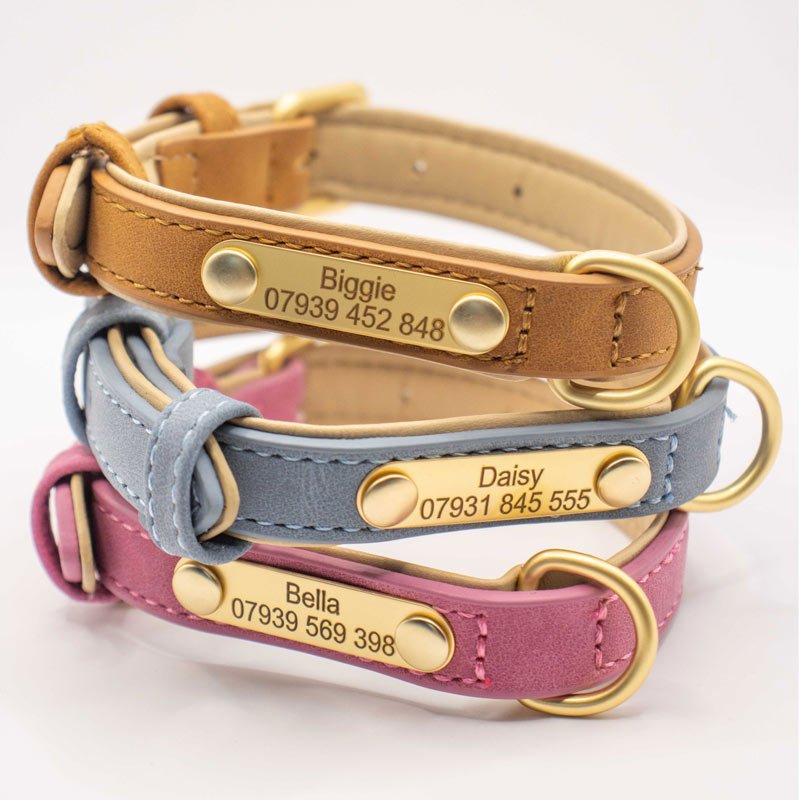
Example layout – all details are made up.
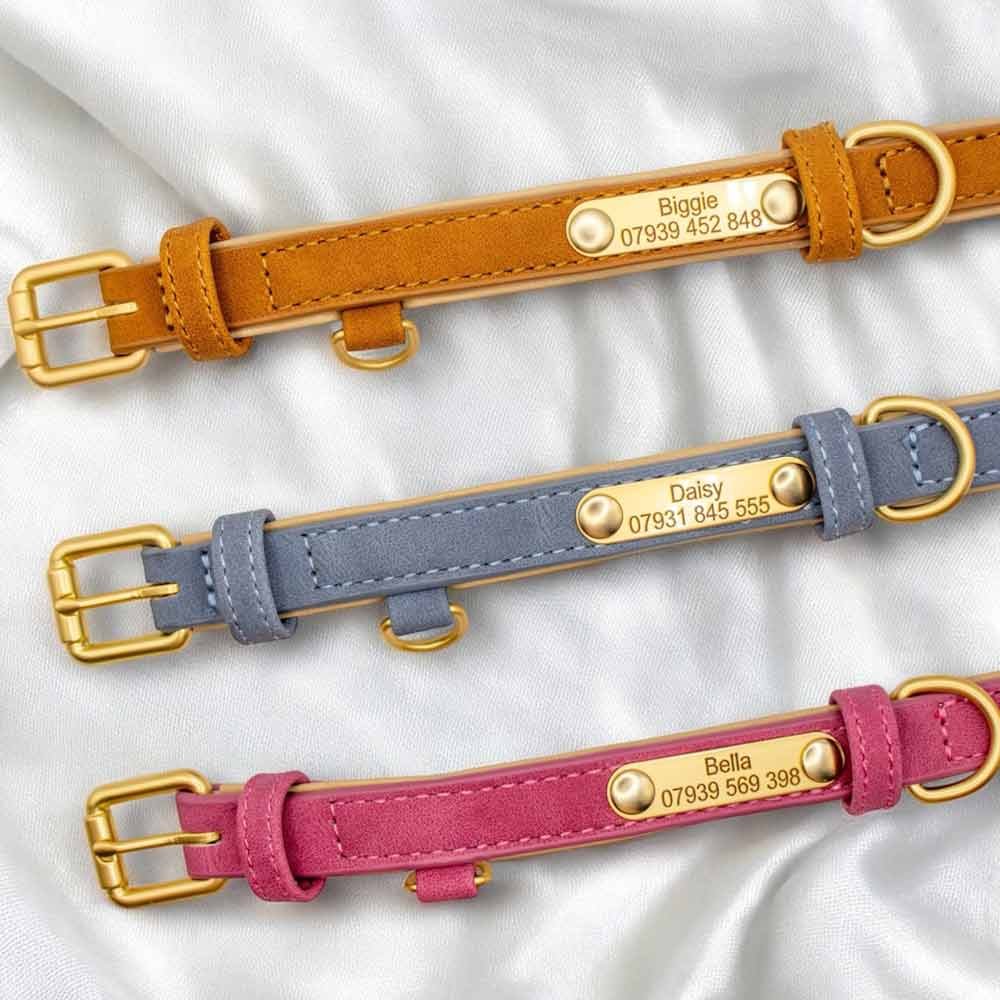
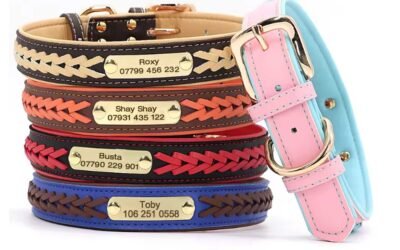
Engraved name plates keep your details on the collar itself.
What we recommend adding (and leaving off)
The legal minimum keeps you on the right side of the law. A few extra words can make the difference between a lost dog being home in an hour or spending a night in kennels.
✔ Worth adding
- A mobile number – whoever finds your dog can call you straight away.
- A second number – useful if you’re often out of signal or at work.
- “I’m microchipped” – tells finders a vet or warden can scan for your details.
- Medical needs – e.g. “Needs daily medication” for dogs who can’t go without.
✘ Think twice about
- Your dog’s name – some owners leave it off so a stranger can’t call the dog by name. It’s your choice; it isn’t required.
- Too much text – tiny, crowded lettering is hard to read and wears away faster.
- Out-of-date details – moved house or changed number? Replace the tag straight away.
Tag vs microchip – do you need both?
Yes. Microchipping is compulsory for dogs in England, Scotland and Wales (by the time a puppy is eight weeks old), but a microchip does not replace the legal need for an ID tag. Read the GOV.UK microchipping guidance.
| ID tag | Microchip | |
|---|---|---|
| Legally required? | Yes, in public places | Yes, for dogs |
| Who can read it? | Anyone who finds your dog | Only someone with a scanner (vets, wardens, rescues) |
| Can it fall off? | Yes, if the collar or ring fails | No – it’s under the skin |
| Fastest way home? | ✔ A finder can phone you straight away | Only once the dog reaches a scanner |
Think of the tag as the quick route home and the microchip as the permanent back-up. Remember to keep your microchip database details up to date too.
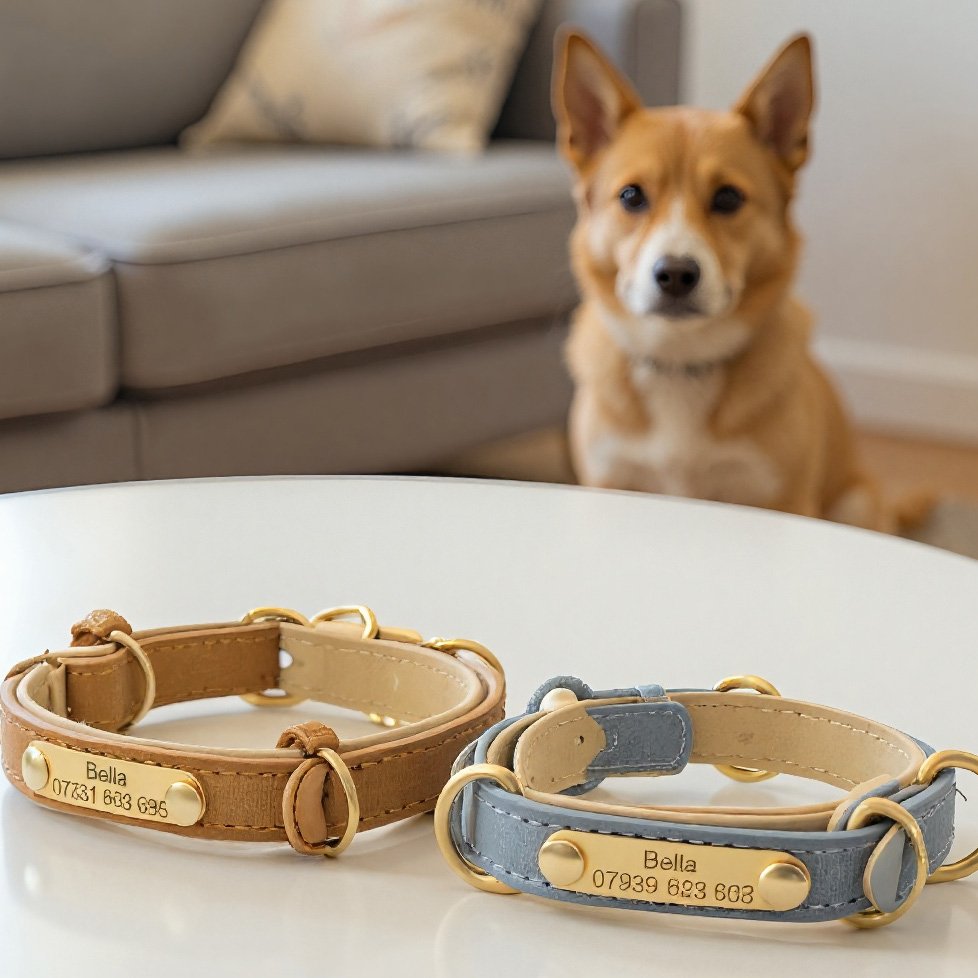
The tag is the quick route home – the microchip is the back-up.
Which dogs are exempt?
The Order lists a few working dogs that don’t have to wear a collar and tag while they’re working:
- Dogs used for sporting purposes, or packs of hounds
- Dogs used to capture or destroy vermin
- Dogs used for driving or tending cattle or sheep
- Police and armed forces dogs, and dogs used by HM Revenue & Customs
- Dogs used in emergency rescue work
- Guide dogs and other registered assistance dogs
For everyday pet dogs, there are no exemptions.
What if my dog wears a harness?
The law talks about a collar. Clipping a tag to a harness is better than nothing, but to be fully compliant the safest option is for your dog to wear a collar with a tag or engraved nameplate as well – even if you attach the lead to the harness.
Choosing a dog tag that lasts
A tag only works if it can still be read after months of walks, swims and scratching. Look for:
- Deep engraving rather than printing – printed text rubs off.
- Tough materials such as stainless steel or brass, which won’t rust or bend easily.
- A secure fixing. Split rings can open over time; a tag or nameplate fixed directly onto the collar can’t get lost on its own.
- Clear, large lettering – stick to the essentials so the text can be a sensible size.
Want to know which collar material suits your dog best? Read our guide to choosing the right material for your dog’s collar.
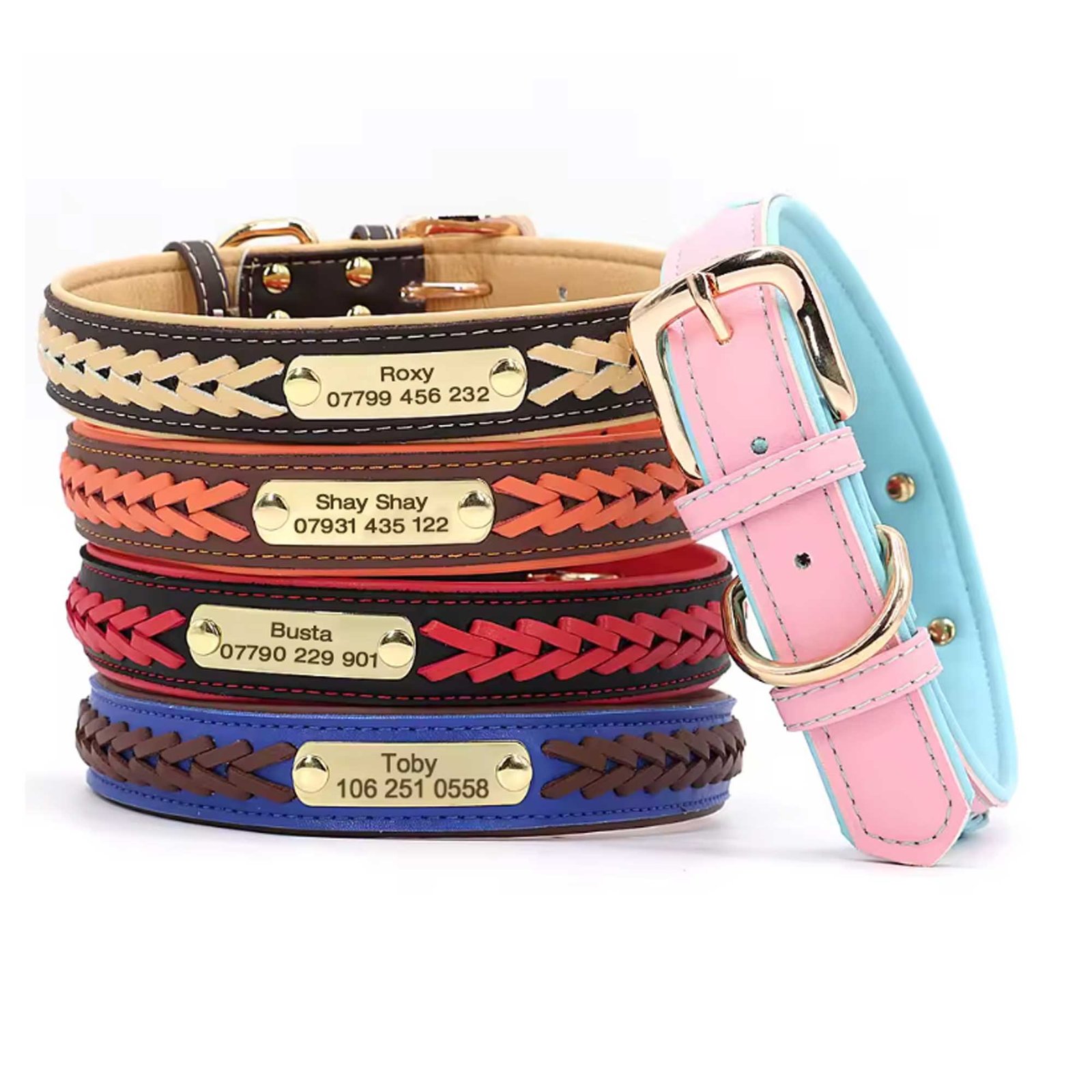
A nameplate fixed to the collar can’t get lost on its own.
Get a personalised dog collar that ticks every box
Our personalised collars and nameplates are engraved with your details, so your dog is legal, looks great and has the best chance of getting home safely.
Dog tag FAQs
Is it a legal requirement for a dog to wear a tag in the UK?
Yes. Under the Control of Dogs Order 1992, dogs in a public place must wear a collar showing the owner’s name and address, including postcode – either on the collar itself or on an attached tag. A few working dogs are exempt while working.
Do I have to put my phone number on my dog’s tag?
No, a phone number isn’t a legal requirement, but it’s strongly recommended. It means whoever finds your dog can contact you straight away.
Should I put my dog’s name on the tag?
It’s not required and it’s a personal choice. Some owners leave the dog’s name off so that strangers can’t easily call the dog by name.
Does my dog still need a tag if it’s microchipped?
Yes. Microchipping is also compulsory, but it doesn’t replace the legal need for a collar and ID tag when your dog is in a public place.
What happens if my dog doesn’t have a tag?
It’s a criminal offence and you could be prosecuted and fined. Your dog may also be treated as a stray if picked up by a dog warden.
This guide is general information, not legal advice. Always check the official legislation and GOV.UK for the latest rules.
More from our blog: The benefits of a reflective cat collar · Which dog collar is best?
More from the blog
Personalised Dog Collar or ID Tag? Which Is Best for Your Dog
Dangling ID tag or personalised dog collar? What UK law requires, the pros and cons of each, and how to choose the best option for your dog.

Why You Should Personalise Your Pet’s Collar
Four good reasons to personalise your pet’s collar – from getting a lost pet home fast to avoiding mix-ups – plus what to include.

The Benefits of a Reflective Cat Collar
How reflective cat collars help your cat be seen at night, why a quick-release buckle matters, and how to fit one safely.